After founding device companies worth billions, Manny Villafaña says his newest will be bigger than all of them combined

Manny Villafaña and his team at Medical 21 have developed an artificial artery called Maverics, pictured here in animal testing. [Photo courtesy of Medical 21]
Manny Villafaña says his latest medical device will be “the single biggest product ever developed to be put in the human body.”
After founding three device developers acquired by major OEMs for a combined $67.4 billion — St. Jude Medical, Cardiac Pacemakers Inc. (CPI) and ATS Medical — the serial medtech entrepreneur and his new Minneapolis-area team at Medical 21 have developed a first-of-its-kind regenerative artificial artery.
Made of nitinol and an absorbable polymer, the graft is designed to eliminate blood vessel harvesting in coronary artery bypass grafting (CABG) procedures. CABG is the most commonly performed major surgery worldwide, with an estimated 800,000 procedures annually.
Villafaña says his novel Maverics artificial graft could have a total addressable market of $15 billion to $20 billion.
“That’s my market, and that’s only in the heart,” he said in a Medical Design & Outsourcing interview. “… This device can be used in other parts of the body: peripheral, dialysis, brain, urology, pediatric.”
MDO Min-Vasive Medtech: Hear Villafaña discuss the technology and what he’s learned in his long medtech career on Aug. 18
Villafaña said the graft could save $4 billion to $8 billion annually in Medicare expenditures, decrease patient morbidity and recovery time, expand patient access to CABG and slash procedure time.

Medical 21 founder and CEO Manny Villafaña is a serial medtech entrepreneur who’s launched many medical device companies, including several that sold to large OEMs. [Photo courtesy of Medical 21]
“[Traditionally] from the moment the patient is rolled into the OR to the time a doctor finally got a vessel to put on the heart was over two hours,” he said. “I can get a vessel into your hands to put on the heart in less than 10 seconds. … You’ve eliminated pain, infection, rehabilitation, [and learning] how to walk again.”
The percentage of CABG surgeries performed has decreased over the past 30 years as patients opt for less invasive, alternative options like medication and percutaneous coronary intervention.
But Medical 21 says the increasing prevalence of obesity, diabetes mellitus, hypertension, drug abuse, and chronic medical conditions — plus increases in the geriatric population — will fuel growth in the years ahead.
“Everybody tried to do this,” he said. “Medtronic, St. Jude, etc. have all tried to do this over the last 60 years and no one’s done it.”
Maverics’ design elements
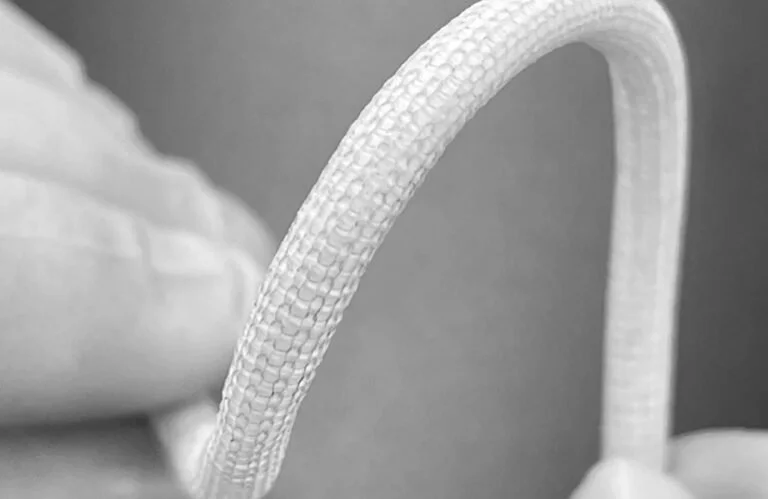
The Medical 21 Maverics device is made of nitinol wire and a synthetic, absorbable polymer. [Photo courtesy of Medical 21]
In its current design, Maverics is a 4mm graft incorporating a reabsorbable synthetic polymer scaffold and nitinol wire designed to function as a flexible blood conduit.
It’s engineered to integrate with a patient’s cells after implantation and support natural healing while avoiding rejection. Villafaña said 4mm is the “ideal size” for a graft, and its materials enable the surgeon to shorten the graft as needed for an individual patient. Maverics could also expand access to CABG for patients with diabetes or amputations who were once ineligible for the procedure.
Maverics also offers surgeons predictability that autologous vessels can’t provide. Physicians don’t know what size vessels are available for harvesting from the patient after beginning the procedure, he said, and those vessels could be damaged or diseased.
“You don’t know what you’re going to get,” Villafaña said. “Here, you know exactly what you’re going to get every single time.”
The graft is shipped sterile in final packaging for on-the-shelf storage at hospitals for up to two years until a surgeon needs it.
Maverics is still in the preclinical development stage. Early animal testing has yielded positive results, the company said, with histology showing host tissue remodeling and a maintained luminal pathway in sheep at two years post-implant, demonstrating graft integration across the implant length. In another ovine study, three-year angiograms showed sustained patency of the graft.
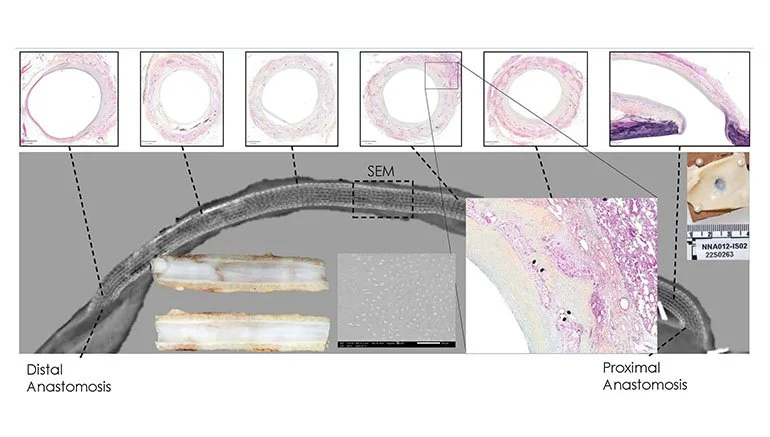
Histology showed host tissue remodeling and a maintained luminal pathway in sheep at two years post-implant, demonstrating graft integration across the implant length. [Image courtesy of Medical 21]
“When the doctors look at [the pre-clinical results], they say, ‘Manny, that’s it, when can we get it?” Villafaña said. “Right now we’re getting ready to begin our human clinical work.”
Medical 21 plans to complete an additional sheep study before submitting an investigational device exemption (IDE) request to the FDA in the second quarter of 2027 and pursuing an early feasibility study in the U.S., according to a filing with the U.S. Securities and Exchange Commission in ahead of a planned initial public offering (IPO).
“I’ve done seven IPOs. … We were all set and ready to go in March, and bingo, on Feb. 28, somebody starts dropping bombs and the IPO market for small companies was shut down,” Villafaña said. “It’s still shut down, so right now we’re running out of cash. And I’m looking for people to help us be able to continue while we wait for the IPO window to open or carry our clinical trial to the point where some investors, some strategics will be interested.”
(Villafaña shared his latest investor presentation with MDO, which you can download here.)
The first-in-human study will evaluate procedural feasibility, graft handling, early patency, and key safety outcomes in patients undergoing CABG for bypassing severely diseased coronary arteries with insufficient vessels to complete revascularization.
Villafaña says Maverics will be more revolutionary than pacemakers, heart valves, stents and defibrillators combined, if Medical 21 can bring it to market. And from our interview, it’s clear he’s got plenty of fight left in him.
“I’m in the middle of my career, not the end of my career,” he said.